
How to Look Up Fayette County Jail Population Data
The primary public source for current Fayette County jail population data is the LFUCG Division of Community Corrections portal at jail.lexingtonky.gov. That portal shows a live "Current Jail Population" count and a "Booked in the Last 48 Hours" list. Both sections reflect the Fayette County Detention Center roster as it stands at the moment of the search. The site does not publish a daily summary number as a static headline figure, but the underlying data is live custody information pulled directly from the booking system.
For county-level trend data beyond the live portal, the Kentucky Department of Corrections posts public information reports on its website. These include a Daily Count Sheet, Daily Releases, and a Weekly Jail report that covers all county jails across the state. The DOC Weekly Jail report is the closest thing to a regular official population count for Fayette specifically. The Kentucky Court of Justice CourtNet analytics system has published Fayette-specific pretrial release outcomes, including figures for January through July 2025 covering misdemeanor charges. Those court metrics do not equal a jail census, but they add context to how the pretrial side of the population flows. None of these sources show a single official rated-capacity or average-daily-population number for Fayette County in the current official documentation reviewed.
The LFUCG portal also carries a disclaimer that is worth knowing: arrest information reflects charges as filed at booking, not final court findings. Data should be verified with Fayette District and Circuit Courts. Anyone relying on the live portal for official or legal purposes must confirm details directly with the detention center or the relevant court division.
Fayette County Jail Capacity Overview
The Fayette County Detention Center is the only county-operated jail facility in Fayette County. It is run by the LFUCG Division of Community Corrections, not the Fayette County Sheriff. The Sheriff handles court security, warrants, and fugitive work, but does not operate the jail. That split is specific to Fayette and differs from most Kentucky counties where the sheriff runs the jail. The detention center at 600 Old Frankfort Circle holds people both before and after court disposition.
A rated capacity figure for the Fayette County Detention Center is not published in the current official online sources reviewed for this page. The LFUCG Community Corrections page provides the address, phone number, and administrative hours but does not list a bed count. To get current capacity information, call the facility directly. The table below reflects what the official record shows.
| Facility | Operator | Address | Phone | Rated Capacity |
|---|---|---|---|---|
| Fayette County Detention Center | LFUCG Division of Community Corrections | 600 Old Frankfort Circle, Lexington, KY 40510 | (859) 425-2700 | Not published; call (859) 425-2700 |
Administrative hours at Community Corrections are Monday through Thursday, 9 a.m. to 5 p.m., and Friday, 8 a.m. to 4 p.m. The detention center itself operates around the clock. For time-sensitive capacity questions, call the main line outside of business hours and ask for the shift commander.
Note: Lexington also has a Federal Medical Center operated by the U.S. Bureau of Prisons. That is a separate federal facility and its population is not part of Fayette County's local jail count.
Average Daily Population at the Fayette County Detention Center
An official average daily population (ADP) figure for the Fayette County Detention Center is not available in the inspected current official sources. LFUCG Community Corrections does not appear to publish an annual report or statistical summary of the detention center's ADP on its public website. The closest public data points are the live current-population portal and the Kentucky DOC's Weekly Jail report, which captures statewide county jail data on a rolling basis.
For anyone who needs an official ADP figure, the recommended path is to submit an open records request to LFUCG under KRS 61.872, the Kentucky Open Records Act provision governing public records inspection. The LFUCG Community Corrections page is the starting point for that request. Responses to an open records request are generally due within five business days under Kentucky law. An ADP derived from the Weekly Jail report would be the most consistent baseline against which to compare any locally provided number.
Researchers and journalists tracking population over time have used the Vera Institute of Justice's incarceration trends tool, which compiles county-level jail data sourced from Bureau of Justice Statistics Annual Survey of Jails. Vera's Fayette County page should be checked directly, because its data are sourced from BJS surveys and have a reporting lag of one to two years. Vera is not an official government source, and its figures should be cited as third-party context, not as LFUCG-reported data.
Demographic Breakdown of Fayette County Inmates
Official demographic data for the Fayette County Detention Center population, including gender distribution, racial composition, and age ranges, is not published in the current official sources reviewed. LFUCG Community Corrections does not appear to release a public breakdown of inmate demographics in an accessible format online. Demographic figures shown on some third-party sites are typically derived from BJS survey data, not from direct LFUCG reporting, and may reflect a prior survey year.
For context on the broader Fayette County population, the U.S. Census QuickFacts for Fayette County provides current demographic data on residents. That data covers the general population, not the jail population, and should not be treated as a proxy for inmate demographics. The Census page was last updated with 2020 decennial and American Community Survey estimates.
The screenshot below, sourced from the U.S. Census Bureau's QuickFacts page for Fayette County, shows the county's demographic breakdown as of the most recent census data available.
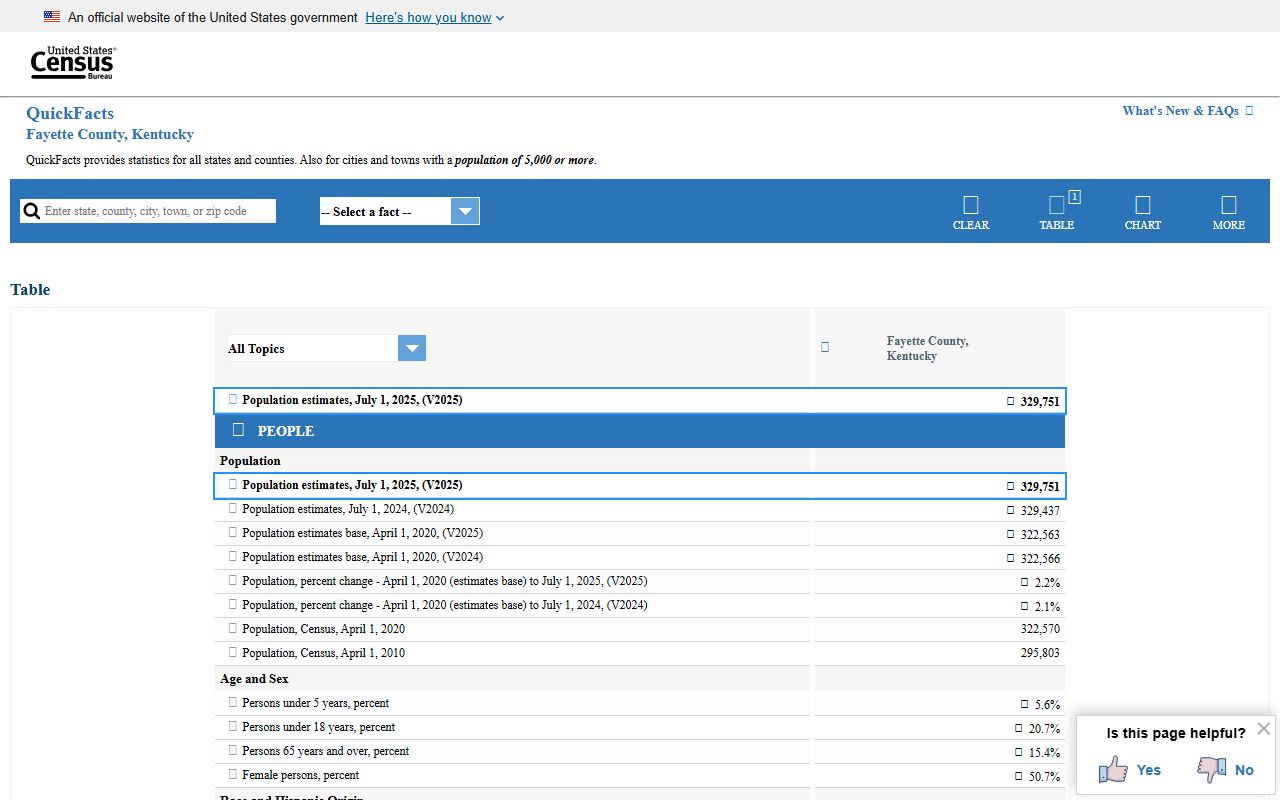
Census data shows Fayette County's general population context. These are county resident demographics, not jail demographics, and are provided here as background only. Actual inmate demographic breakdowns for the Fayette County Detention Center require a direct open records request to LFUCG.
Nationally, the Bureau of Justice Statistics reports that local jails hold a population that skews heavily male and younger than the general population. BJS data from the most recent Annual Survey of Jails shows males account for roughly 85 percent of the jail population nationwide. These national figures are provided as context and do not represent Fayette County-specific data.
| Demographic Category | Fayette County Detention Center | National Jail Average (BJS) |
|---|---|---|
| Male | Not published by LFUCG | Approx. 85% |
| Female | Not published by LFUCG | Approx. 15% |
| Age 18-34 | Not published by LFUCG | Largest age cohort nationally |
| Race/Ethnicity | Not published by LFUCG | Varies by BJS annual survey |
Note: National averages are from Bureau of Justice Statistics jail surveys. Fayette County-specific figures require an open records request to LFUCG.
Pretrial vs. Sentenced Population in Fayette County
A precise pretrial-versus-sentenced breakdown for the Fayette County Detention Center is not listed in current official LFUCG publications. Nationwide, the Bureau of Justice Statistics consistently finds that the majority of people in local jails on any given day are pretrial detainees, meaning they have not been convicted of the charge that put them there. BJS data shows pretrial detainees make up roughly 68 to 70 percent of the national jail population in recent surveys.
For Fayette specifically, the Kentucky Court of Justice CourtNet analytics system published pretrial release outcome data for Fayette County covering January through July 2025. Those figures cover cases where pretrial release was decided in Fayette District and Circuit Courts. They are a court case metric, not a direct census of detention center occupancy, but they indicate that pretrial release decisions are actively tracked and documented in the county's court data system. Researchers seeking a local pretrial-to-sentenced ratio should check CourtNet analytics and the DOC Weekly Jail report in combination, or submit an open records request to LFUCG.
| Status | Fayette County (LFUCG) | National Average (BJS) |
|---|---|---|
| Pretrial (not convicted) | Not published by LFUCG | Approx. 68-70% |
| Sentenced / Post-conviction | Not published by LFUCG | Approx. 30-32% |
The national figures come from the BJS Annual Survey of Jails. Fayette County-specific numbers are not in the public record as currently published. The court analytics data from the Kentucky Court of Justice is the closest official source for pretrial patterns in Fayette.
Misdemeanor vs. Felony Population in Fayette County
The Fayette County Detention Center holds people charged with both misdemeanors and felonies. Under Kentucky law, felony charges are brought through Circuit Court after grand jury indictment; misdemeanor and traffic charges are handled in District Court. Both groups may end up at the detention center pretrial if bail is not posted. Felony defendants held on serious charges, or who cannot make bond, stay at the facility until a Circuit Court resolution. Misdemeanor detainees typically cycle through faster, but some remain for weeks if fines or conditions are unmet.
The Kentucky Court of Justice CourtNet analytics system has tracked specified misdemeanor charges in Fayette County for fiscal year 2025 as a court case metric. That data covers case filings and dispositions, not detention center occupancy. An official breakdown of the detention center population by charge severity is not published in current LFUCG sources reviewed. To see how many people at the Fayette County Detention Center are held on felony versus misdemeanor charges, call (859) 425-2700 or submit a KRS 61.872 open records request to LFUCG Community Corrections.
In general terms, local jails nationally hold more people on felony charges than misdemeanor charges when measured by daily population, because felony defendants tend to be held longer pretrial. BJS data confirms this pattern across the country. Whether Fayette mirrors the national split is not confirmed without local-specific data.
Mental Health and Medical Population at the Detention Center
LFUCG Community Corrections lists a range of inmate services and programs at the Fayette County Detention Center, including drug and alcohol rehabilitation, GED preparation, job skills, parenting skills, religious services, and recreation. Drug and alcohol treatment is documented in official LFUCG program descriptions. These programs are relevant to the health needs of the incarcerated population, though they do not constitute published mental health or medical census data.
A formal mental health population figure, such as the percentage of inmates receiving psychiatric services or medication, is not in the current official public documents reviewed for Fayette County. This is a common gap at the local jail level nationally. BJS does publish data on mental health treatment in jails at the state and national level through its Survey of Inmates in Local Jails, and that survey consistently shows a substantial share of the jail population nationwide reporting a history of mental health problems. BJS estimates that roughly a third of jail inmates have been told by a mental health professional that they have a mental disorder.
Kentucky DOC's VINE system gathers booking data from jail booking systems, prisons, and mental health facilities statewide. That integration means some people who cycle through the Fayette County Detention Center may also have histories tracked in DOC mental health records. Families or advocates who need information on a specific person's medical or mental health status while in custody should contact the facility directly at (859) 425-2700 or reach the chaplain during normal business hours at the same number.
National and State Context for Fayette County Jail Population
The Bureau of Justice Statistics tracks jail populations across the United States through the Annual Survey of Jails and the Census of Jails. As of the most recent available BJS report, the national jail incarceration rate sits at roughly 220 to 230 people per 100,000 U.S. residents. That number has declined from a peak of about 260 per 100,000 around 2008 and has not fully recovered to pre-COVID levels. The BJS site at bjs.ojp.gov is the authoritative source for these figures and publishes updated reports as surveys are completed.
Kentucky's jail rate historically runs above the national average. The Vera Institute of Justice, a nongovernmental research organization, places Kentucky among states with higher-than-average local jail use. Vera's incarceration trends tool at incarcerationtrends.vera.org compiles BJS survey data to show county-level trends over time. Vera is not a government source; its figures are based on BJS data with a reporting lag, and they should be read as contextual estimates rather than official government-reported numbers.
The screenshot below is from the Bureau of Justice Statistics, the federal agency responsible for collecting and publishing official jail population data for the United States.

BJS publishes the most comprehensive national and state-level jail data available. Fayette County-specific rates derived from BJS surveys should be checked on the Vera tool or confirmed through a direct open records request to LFUCG.
| Level | Jail Population per 100,000 Residents | Source |
|---|---|---|
| Fayette County | Not officially published | LFUCG (no public figure found) |
| Kentucky (state) | Above national average (BJS/Vera) | BJS Annual Survey of Jails; Vera Institute |
| United States | Approx. 220-230 per 100,000 | BJS Annual Survey of Jails |
The county cell is left blank because LFUCG has not published an official per-capita rate. Fabricating a county rate would misrepresent the official record. The BJS and Vera figures above are clearly labeled as state and national data.
Fayette County Jail Population Trends Over Time
Long-term trend data for the Fayette County Detention Center is not consolidated in a single official public source. LFUCG Community Corrections does not appear to publish annual population tables or five-year trend charts on its website. The Kentucky DOC Weekly Jail report captures statewide data on a rolling weekly basis, but it does not appear to maintain a publicly accessible multi-year archive for individual counties in a way that allows easy trend comparison.
National trends provide useful background. BJS data shows that U.S. jail populations rose steeply from the 1980s through the late 2000s, peaked around 2008 at roughly 785,000 people, and then declined steadily through the mid-2010s. The COVID-19 pandemic drove a sharp drop in 2020, followed by a partial rebound. As of the most recent survey year available from BJS, the national total jail population remained below the 2008 peak. Kentucky followed a broadly similar arc, though with a slower early decline and persistent above-average incarceration rates in rural counties that can mask different patterns in urban counties like Fayette.
Locally, recent LFUCG news releases confirm that the Fayette County Detention Center is actively used as the primary pretrial detention facility for Lexington-area arrests. Sheriff warrants, Lexington Police bookings, and state police arrests all route through the same facility. The Kentucky State Police and Fayette Sheriff's fugitive-warrant program also brings defendants back from out of state to await judicial process at the detention center. Those flows all affect the daily population, and they tend to rise or fall with local arrest rates and court throughput, not just capacity decisions.
Anyone tracking Fayette County jail population over time should use the Vera Institute incarceration trends tool as a starting point, then verify current figures against the DOC Weekly Jail report and the LFUCG live portal. For historical data older than what Vera covers, an open records request to LFUCG under KRS 61.871 is the appropriate route.
Searching for Fayette County Inmate Records by Name
This page covers aggregate jail population data, not individual inmate lookups. To search for a specific person currently held at the Fayette County Detention Center, use the name-based search tool described on the Fayette County inmate records page. The live roster at jail.lexingtonky.gov supports searches by last name, first name, middle name, and inmate ID. Individual booking details, bond amounts, and charge information are also accessible through that system or by calling (859) 425-2700.
Where the Data Comes From
Several official and recognized sources feed Fayette County jail population data, and each has its own update schedule and scope. Understanding the source matters when comparing numbers across reports.
- LFUCG Current Jail Population Portal
- Live data from the LFUCG Division of Community Corrections booking system. Updates in near real time. Shows current custody and last-48-hours bookings. Does not publish aggregate totals or trend charts. Best for checking current status of an individual or getting a snapshot of today's population.
- LFUCG Community Corrections
- The administrative home page for the detention center. Provides facility contact information, program descriptions, and policy pages. Does not publish population statistics directly but is the right place to start an open records request for internal data.
- Kentucky Department of Corrections Public Information Reports
- The DOC publishes a Daily Count Sheet, Daily Releases, and Weekly Jail report. These provide statewide county jail counts on a regular schedule. The Weekly Jail report is the most consistent public source for tracking Fayette County population week over week. Access is through the Kentucky DOC public information page.
- Bureau of Justice Statistics (BJS)
- The federal statistical agency that surveys local jails annually. BJS publishes the Annual Survey of Jails and the Census of Jails. Data has a reporting lag of one to two years. BJS figures are the standard for national and state-level comparisons. All national rate figures on this page come from BJS.
- Vera Institute Incarceration Trends
- A nongovernmental research resource that compiles BJS survey data into county-level trend charts. Vera is not a government source. Its figures carry the same reporting lag as the BJS surveys they are drawn from. Use Vera for historical trend context, not for current population counts.
Court-side data from the Kentucky Court of Justice, including pretrial release outcomes from CourtNet analytics, covers case and release decisions rather than daily facility headcounts. It is useful for understanding how pretrial populations are managed but is not a substitute for a direct jail census. For questions about Fayette County court records tied to specific cases, the Circuit Court Clerk's office is the official custodian. For arrest records and booking history, the Lexington Police Central Records Unit and the detention center both hold relevant documentation.