
Kentucky Open Records Act in Fayette County
Kentucky's public-records framework is the Kentucky Open Records Act, found at KRS 61.870 through KRS 61.884. The General Assembly enacted it in 1976. The Act declares that free and open examination of public records is in the public interest and that exceptions must be strictly construed. Under KRS 61.871, the intent of the Act is clear: public records belong to the public unless a specific exemption applies. That policy covers city and county governing bodies, agencies created by state statute, and local public offices, which means it applies broadly across Fayette County government.
The Commonwealth transparency page explains that KRS 61.870 defines "public agency" and "public record" broadly. A public record is any document, paper, photograph, film, card, tape, disk, diskette, recording, or other documentary material, regardless of physical form, that is prepared, owned, used, in the possession of, or retained by a public agency. That definition covers digital files, email, databases, and hard copies. Private entities and their internal documents generally fall outside the Act.
The Kentucky transparency portal hosts open-records information for state and local agencies. The Act covers Fayette-area agencies like Lexington-Fayette Urban County Government, the Fayette County Clerk, the Sheriff's office, and Lexington Police. Each agency designates an official records custodian and sets its own submission procedures within the statutory framework.
The transparency portal referenced above provides an overview of the Act and links to agency policies. The screenshot below was captured from the Commonwealth's open records overview.
The Kentucky Open Records Act overview on the state transparency portal explains the public inspection right and how state and local agencies implement the law.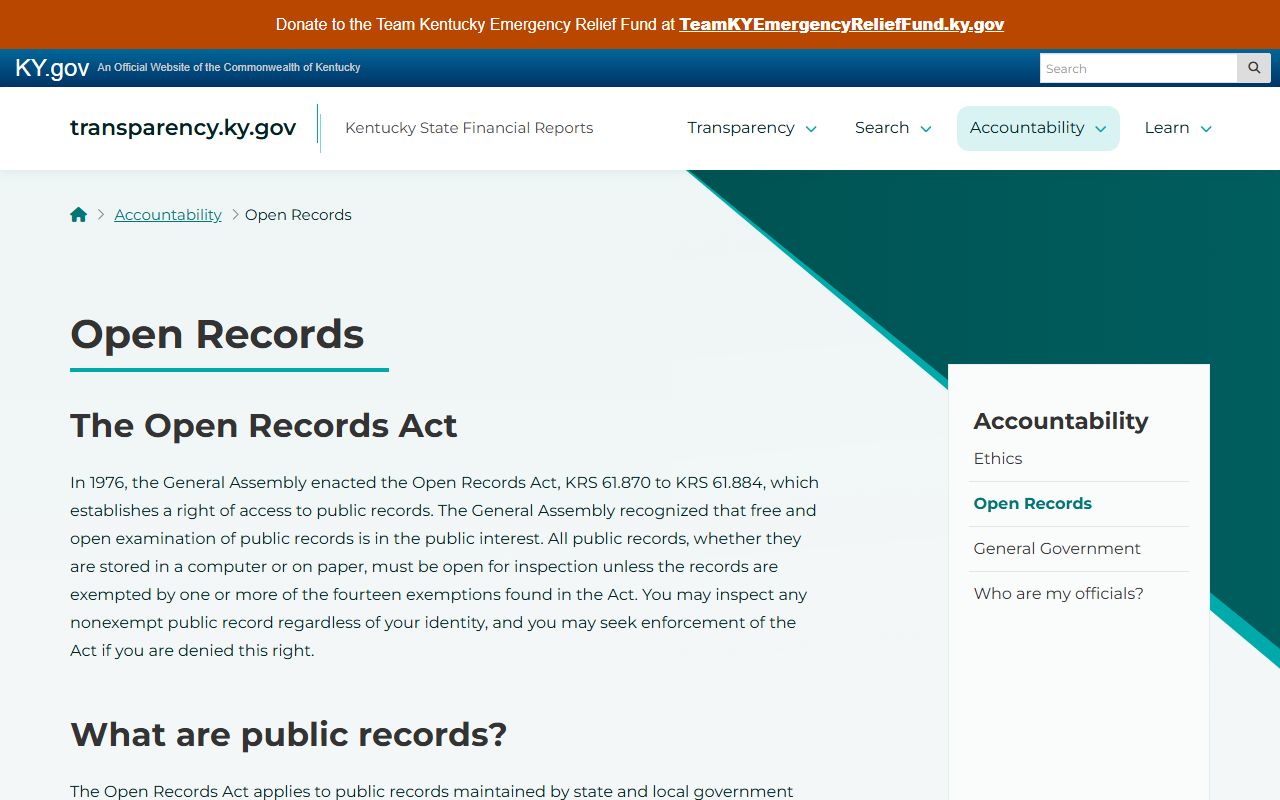
The transparency portal provides a direct entry point for understanding the state's open records framework before submitting a Fayette County public records request to any local agency.
Court Records vs Agency Records in Fayette County
A common mistake is sending an open-records request to the wrong office. Court case files are not the same as general government records. If you want a criminal case file, a civil lawsuit, a divorce decree, an eviction judgment, or a probate order, the correct path is the Fayette Circuit Court Clerk, not LFUCG and not the County Clerk. The Kentucky Court of Justice says the Administrative Office of the Courts does not maintain local court case records, and AOC cannot provide access to them. All requests for court case files start with the clerk of the court that heard the case.
The split in Fayette County is between three record custodians. The Circuit Court Clerk, currently Vincent Riggs, keeps all Circuit, Family, and District Court case records. The Fayette County Clerk keeps recorded documents like deeds, mortgages, marriage licenses, liens, and fiscal records. LFUCG and its departments, including the police and Community Corrections, keep executive-branch agency records. A person looking for a specific Fayette County court case should go to the Circuit Court Clerk first. A person looking for a deed or marriage license should contact the County Clerk.
The Open Records Act does not govern court clerks in the same way it governs executive-branch agencies. Court records have their own access framework under court rules and Kentucky confidentiality statutes. Some court records are fully public. Others are sealed, restricted to parties, or confidential by law. Juvenile and mental health cases in Fayette District Court are confidential by statute. Adoption and certain Family Court records are restricted. If a court record is public, the Circuit Court Clerk is still the place to request it, not an KORA request to the court clerk's office as an "agency." See the court records page for the full process.
Note: When records touch both agency and court sources, you may need two separate requests to two separate offices.
Fayette County Agencies Subject to the Open Records Act
Three agencies come up most often when people search Fayette County public records under KORA. Each has its own custodian, submission address, and fee rules.
The Fayette County Attorney's Office maintains its own open-records policy. The official records custodian is John Hayne, First Assistant Fayette County Attorney, reachable at 201 East Main Street, Suite 600, Lexington, KY 40507, by phone at (859) 254-4941, or by email at john.hayne@fayettecountyattorney.com. Office hours are Monday through Friday, 8 a.m. to 4:30 p.m. Requests must be in writing and may be submitted by mail, in person, or by email. The policy commits to a five-business-day response.
The Fayette County Clerk processes open-records requests under KRS 61.870 through 61.884. The Clerk's policy notes that some documents are excluded in whole or in part under KRS 61.878 when exempt information is present. The Clerk's office is at 162 East Main Street, Room 132, Lexington, KY 40507, phone (859) 253-3344. Copies are priced first under statutory fee schedules, including KRS 64.012 and KRS 64.019.
Lexington Police has its own open-records process through the Lexington Police open records page. Requests must be in writing. The page adds a requirement specific to police records: the requester must state that they are a resident of the Commonwealth of Kentucky. Every police open-records request must include a statement explaining how the person is a Kentucky resident.
How to File a Fayette County Public Records Request
The right of inspection under KRS 61.872 comes with a specific process. The statute governs how inspection works and what a written request must include. Skipping steps or sending a request to the wrong office is the most common reason requests get delayed or returned.
- Identify the agency that holds the records. Court case files go to the Fayette Circuit Court Clerk, not to LFUCG. Land records, deeds, and marriage licenses go to the County Clerk. Police incident reports and body-cam footage go to Lexington Police Central Records. Prosecution records and County Attorney files go to the Fayette County Attorney's Office.
- Prepare a written request. The request must describe the records clearly enough for the agency to locate them. Include the type of document, any case number or date range you know, parties involved if applicable, and the format you prefer (email, paper, electronic file). A vague request for "all records" may draw a clarification reply that adds to your wait time.
- Include your contact information and residency statement if required. At minimum, include your full name and mailing address. If you are requesting police records, add a statement confirming you are a Kentucky resident and explain how you satisfy that requirement. For other agencies, name and address are standard.
- Submit the request by the agency's preferred channel. The County Attorney accepts requests by mail, in person at Suite 600, or by email. Lexington Police accepts requests on their electronic form, by email to ORR@lexingtonky.gov, in person at 150 E. Main St. Monday through Friday 8 a.m. to 5 p.m., by fax to (859) 425-2270, or by mail to the Open Records Unit, Lexington Police Department, 150 E. Main St., Lexington, KY 40507. The County Clerk accepts requests in writing at 162 East Main Street, Room 132.
- Wait for the agency's response. Under KRS 61.872 and the enforcement provisions of KRS 61.880, agencies must respond within five business days. The response either grants access, sets a time for access, or denies the request in writing with a specific statutory exemption cited.
- Pay any applicable fees before receiving copies. The County Clerk requires fees paid in advance. The County Attorney charges nothing for email delivery but charges per page for paper copies. See the fee table below for amounts by agency.
- Receive the records or pursue a denial. If the agency grants access, review or collect the documents. If the agency denies access, the written denial must cite a specific exemption under the Act. You may then seek review through the Office of the Attorney General or file a civil action.
Reading the statute before you file a Fayette County public records request helps you format the request correctly and understand your rights if the agency denies it.
What a Written KORA Request Must Include
Different agencies in Fayette County use different forms and portals, but the core content of a written Kentucky Open Records Act request is consistent. The table below covers what each field is, whether it is required, and notes drawn from the Lexington Police open-records page and the Fayette County Attorney's published policy. Police requests have an added residency-statement requirement that other agencies do not.
| Field | Required | Notes |
|---|---|---|
| Full name | Yes | Your legal name; required by the County Attorney policy and standard across KORA agencies. |
| Mailing address | Yes | Required by County Attorney policy; used for written response and record delivery. |
| Daytime phone number | Yes for police | Required by Lexington Police; helpful for other agencies to clarify requests. |
| Email address | Yes for police | Required by Lexington Police; also used by County Attorney for electronic record delivery at no fee. |
| Specific description of records | Yes | Must be clear enough for the agency to locate the records. Include document type, date range, parties, case number, or any other identifiers you have. |
| Kentucky residency statement | Yes for police records | Lexington Police requires every requester to state that they are a Kentucky resident and explain how they satisfy that requirement. Not required by all Fayette County agencies. |
| Format preference | No | State whether you want email, paper copies, a CD, or in-person inspection. Affects fees charged. |
| Supporting documentation | Sometimes | Lexington Police notes that some records may require supporting documentation. Bring ID for in-person requests. |
Using the Lexington Police open records electronic form is the easiest option for police records because it prompts for each required field. For the County Attorney, email is a direct channel and costs nothing if records can be sent electronically.
Public Records Fees in Fayette County
Kentucky law under KRS 61.874 allows agencies to charge fees for copies. The statute also governs what agencies can charge for compiling records and producing them in different formats. Each Fayette County agency applies its own fee schedule within the statutory limits. The table below shows the documented fees from three agencies' published policies. Fees for the County Clerk are partly set by separate statutory schedules under KRS 64.012 and KRS 64.019, which is why some of its rates differ from standard KORA copy fees.
| Agency | Record / Format | Fee |
|---|---|---|
| Fayette County Attorney | Electronic records by email | No charge |
| Fayette County Attorney | Paper copies (standard) | $0.10 per page |
| Fayette County Attorney | CDs or large files | Material cost plus postage |
| Fayette County Attorney | Commercial-purpose requests | Contract and fees may apply |
| Fayette County Clerk | Standard document copy (per page) | $0.50 per page |
| Fayette County Clerk | Plat copy | $1.00 per page |
| Fayette County Clerk | Non-commercial document copies (KORA path) | $0.10 per page |
| Fayette County Clerk | Non-commercial recordings / computer disks / tapes | $5.00 per copy |
| Fayette County Clerk | Certified copy (land record, first 3 pages) | $5.00 |
| Fayette County Clerk | Certified copy (each page over 3) | $0.50 per page |
| Fayette County Clerk | Postage and handling (mail requests) | $1.00 per document |
Fees at the County Clerk must be paid in advance. The Clerk accepts cash, credit cards, and checks. Personal checks from requesters are accepted by mail. Certified checks, cashier's checks, business checks, and money orders are also accepted. For County Attorney requests delivered by email, there is no charge at all, which makes electronic delivery the most cost-efficient path when available.
Note: Lexington Police fee details were not published in the inspected open-records page; contact the Open Records Unit at ORR@lexingtonky.gov or (859) 425-2270 to confirm current copy charges before submitting.
Response Timeline and Agency Duties
KRS 61.880 sets the response standard for all Kentucky open-records agencies. An agency must respond in writing within five business days of receiving a request. The response must either provide access to the records, state a specific date and time for inspection, or deny the request in writing with the specific statutory exemption cited. A denial that does not cite a specific exemption is itself a violation of the Act. The Fayette County Attorney's policy explicitly cites the five-business-day window and commits to citing statutory exemptions in any denial.
Weekends and state holidays do not count toward the five business days. If a request is received on Friday, the five-day clock generally starts the next business day. In practice, agencies sometimes respond faster than five days for simple, well-described requests, especially for email delivery. Complex requests for large volumes of records or records that require redaction can take longer, but the agency must still provide a written response within the statutory window explaining the delay and giving a final date for production.
Partial responses are allowed when some records are exempt and others are not. Under KRS 61.878, agencies may redact exempt portions of a document and produce the rest. If any portion of a record is withheld, the written denial must explain which exemption covers that portion. You keep the right to the non-exempt parts. Common partial-response situations in Fayette County include police records where an ongoing investigation is cited, or County Attorney records where attorney work product or legal strategy is involved.
What the Fayette County Clerk Maintains
The Fayette County Clerk, currently Susan Lamb, is a separate constitutional office from the Circuit Court Clerk. Her office does not hold court case files. What it does hold is a large and historically deep collection of recorded documents. The Land Records department records legal documents under the Kentucky Revised Statutes. The Clerk's online portal at fayettedeeds.com provides free public searching and viewing of land records from 1970 to present, with many earlier records available in the Non-Indexed Documents section.
Beyond land records, the County Clerk's office handles a range of public documents that fall under KORA when requested. The office keeps records in these categories:
- Deeds, mortgages, and liens (land records from around 1792 to present)
- Marriage licenses and certified marriage copies
- Recorded wills and historical will books (1794 to present)
- Plats and survey records (plats from 1880 to present)
- Corporate filings and business records
- Fiscal court records and property tax bill preparation
- Vehicle title and registration records
- Notary commission records
- Voter registration and election records
For genealogy research, the Clerk's office holds manumission and emancipation documents, "burnt records" from 1794 to 1803, old surveys, orders, deeds of restriction, easements, and commissioner's certificates from 1779 to 1784. The office also has a digital copy of the original Commissioner's Certificate book from 1779 to 1780. Daniel Boone served as a deputy surveyor for Fayette County, and surveys by Boone are on record. Historical requests for those early materials may need to go to the office directly rather than through the online portal.
The Clerk cannot perform title searches or legal research on behalf of requesters. Title-search requests will be returned. If you need a title search, hire a licensed title company or attorney.
Records Exempt from Public Inspection in Fayette County
Not every government record is open. KRS 61.878 lists the categories of public records that may be withheld from public inspection. The Fayette County Clerk's open-records policy cites KRS 61.878 directly for records excluded in whole or in part. Agencies applying these exemptions must still identify which exemption applies and, for partial denials, produce the non-exempt portions of a document.
Common exemption categories that arise in Fayette County agency records include: personnel records whose disclosure would be an invasion of privacy; law-enforcement records compiled in the process of detecting or investigating statutory violations; records confidential by other statutes; attorney work product and privileged materials; records involving trial strategy or pending litigation; and records where disclosure would harm the public interest before a decision is made. Police records for active criminal investigations often fall under the law-enforcement investigation exemption. The County Attorney's legal files may be protected by attorney-client privilege or the trial-strategy exemption.
Court case records have their own separate confidentiality rules that go beyond the KORA exemptions. Juvenile cases in Fayette District Court are confidential by statute and no information is given by phone. Mental health cases are confidential except for appointment orders, judgments, and orders affecting judgments. Adoption, termination of parental rights, and certain Family Court records require party or attorney status or a court order to access. These restrictions apply regardless of whether you frame the request as a KORA request or a court-records request. For restricted court records, contact the relevant clerk division directly to understand the access path. See criminal records for more on what is and is not public in the criminal context.
Lexington Police Open Records in Fayette County
Lexington Police is part of Lexington-Fayette Urban County Government, so its records fall under KORA. The Lexington Police Central Records Unit handles several record types: alarm registration records, background check and criminal records report information, collision and accident reports, online criminal reports, open-records requests, and fingerprinting. Lexington Police notes it does not itself process background checks; that function is directed to the Kentucky Administrative Office of the Courts.
The open-records submission options for police records are the most varied of any Fayette County agency. A person may submit via the electronic form on the police website, by email to ORR@lexingtonky.gov, in person at Lexington Police Department, 150 E. Main St., Monday through Friday 8 a.m. to 5 p.m. excluding holidays, by fax to (859) 425-2270, or by mail to the Open Records Unit, Lexington Police Department, 150 E. Main St., Lexington, KY 40507. Whichever channel you use, the written request must include your name, address, daytime phone, email, and a specific description of the records you want. Supporting documentation may be required for some record types.
The residency statement is a critical element for police open-records requests. The Lexington Police open-records page states that requesters must be residents of the Commonwealth of Kentucky and that every request must include a statement indicating how the person is a Kentucky resident. This requirement can affect out-of-state requesters. If you are not a Kentucky resident, consult the current Lexington Police open-records page for current guidance before submitting, because residency requirements under KORA have been subject to legal interpretation over time.
Crash and accident reports from Lexington Police are separate from court case files. A crash report is a law-enforcement record maintained by the police. A court file for a traffic citation or criminal traffic charge is maintained by the Fayette Circuit Court Clerk. If your purpose is to follow up on a court case after an accident, you may need both: the police crash report from Central Records and the court file from the Circuit Court Clerk.
Key Fayette County Public Records Statutes
The statutes below are the core legal framework for public records access in Fayette County. Knowing them helps when an agency denies a request or cites a vague reason. Each links to the official Kentucky legislature site where the full text is available.
The Kentucky statutes search portal is the official legislative resource for locating the full text of any Kentucky statute cited in a public records request or denial.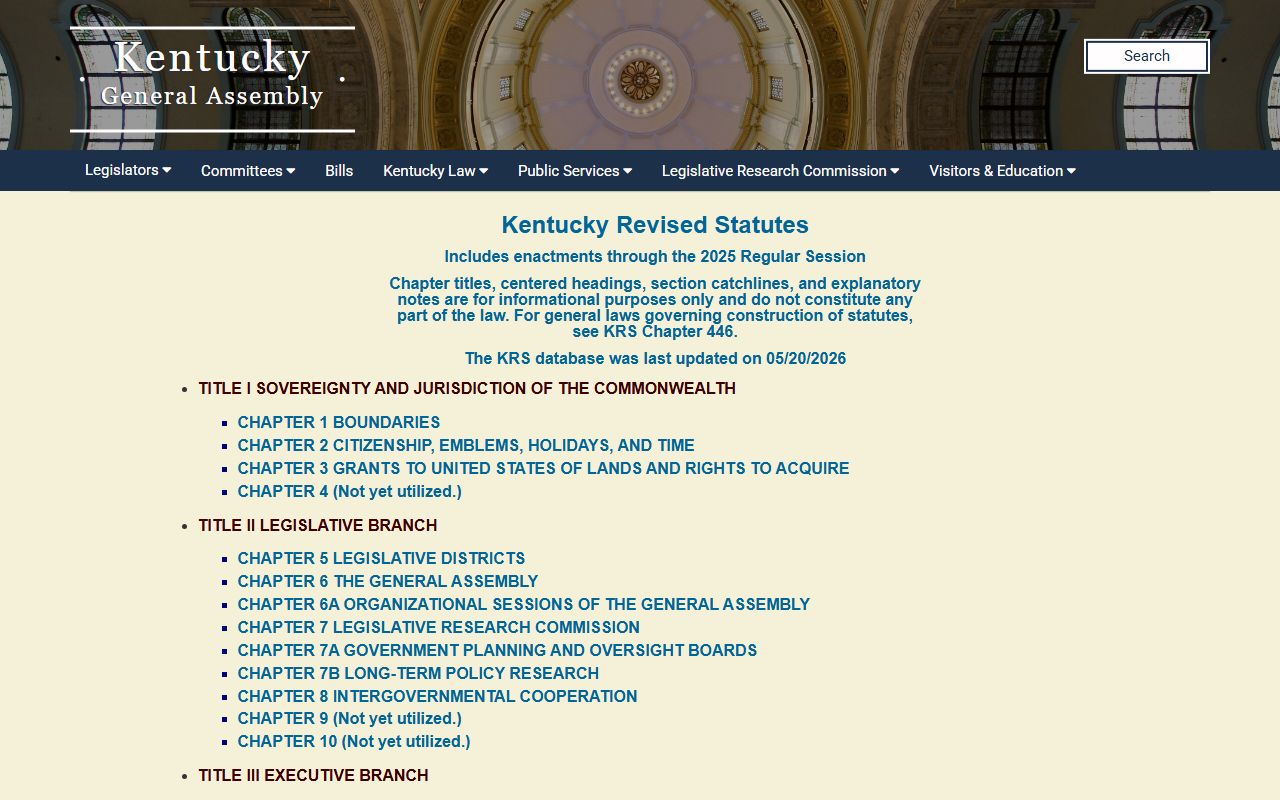
The statutes portal lets you search by chapter or section number, which is useful when an agency cites a specific exemption in a denial and you want to read the full text of that exemption.
- KRS 61.870: Definitions
- Sets out the definitions of "public agency" and "public record" used throughout the Act. A public record includes documents in any format, from paper to digital files, that are prepared, owned, or retained by a public agency.
- KRS 61.871: Legislative Policy
- Declares that free and open examination of public records is in the public interest and that exemptions are exceptions to be strictly construed. This is the foundational policy statement for all open-records disputes.
- KRS 61.872: Right of Inspection
- Governs how inspection works and what a written request must include. Sets the mechanics for submitting requests and the agency's duty to respond.
- KRS 61.874: Copies and Fees
- Authorizes agencies to charge fees for copies within limits. Governs fee schedules, commercial-use contracts, and electronic record delivery. The County Attorney's no-charge email policy and the per-page copy fees both operate under this statute.
- KRS 61.878: Exemptions
- Lists the categories of records not subject to public inspection. Includes personnel records, law-enforcement investigative files, attorney work product, records protected by other statutes, and other categories. Agencies must cite a specific subsection when denying access.
- KRS 61.880: Agency Response
- Requires a written response within five business days. Denials must include the specific exemption relied upon. This statute is the enforcement hook for challenges to unreasonable delays or baseless denials.
If Your Fayette County Public Records Request Is Denied
A denial of a public records request is not the end of the road. Kentucky law gives requesters two main avenues to challenge a denial. The first is to file a complaint with the Office of the Kentucky Attorney General. The AG's office reviews open-records disputes and can issue an opinion finding that the agency violated the Act. AG opinions are binding unless appealed. The second avenue is to file a civil action in circuit court. For a Fayette County matter, that means the Fayette Circuit Court, where the denial can be reviewed as a civil legal matter.
Before either of those steps, review the denial letter carefully. The letter must cite a specific exemption from KRS 61.878 or another applicable statute. If the denial does not cite a specific exemption, or if the cited exemption does not actually apply to the records you requested, that is the basis for your challenge. Agencies sometimes deny records out of habit or to protect internal information that is not actually exempt. Consulting the full text of the cited statute is the best first move.
There is no cost to file an AG opinion request. You write to the Office of the Attorney General with your request letter, the agency's denial, and your argument for why the denial is improper. The AG then asks the agency to justify its position. Many disputes resolve at this stage without litigation. If you need the records for time-sensitive purposes, flag that in your AG complaint because the office can expedite some reviews.
For Fayette County open-records questions, the Fayette County Bar Association and Legal Aid of the Bluegrass may provide guidance or referrals. The Fayette County Legal Help Center at the Circuit Courthouse offers legal information on Thursdays from 11 a.m. to 2 p.m., though open-records disputes are not listed among its guided-interview topics. See also the FAQ page for answers to common questions about Fayette County records access.